12 June 2026
On Friday 29 May, 17 Year 10 Exercise Physiology students attended an excursion to the South Australian Sports Institute (SASI) and Adelaide University Sports Science Hub to conduct different experiments and examine how heart rate responds to exercise in different conditions. Students were able to participate in a range of experiments, such as a VO2 max testing, which examines the maximum amount of oxygen your body can use during intense exercise and body fat and muscle percentage testing using BioPod air displacement technology.
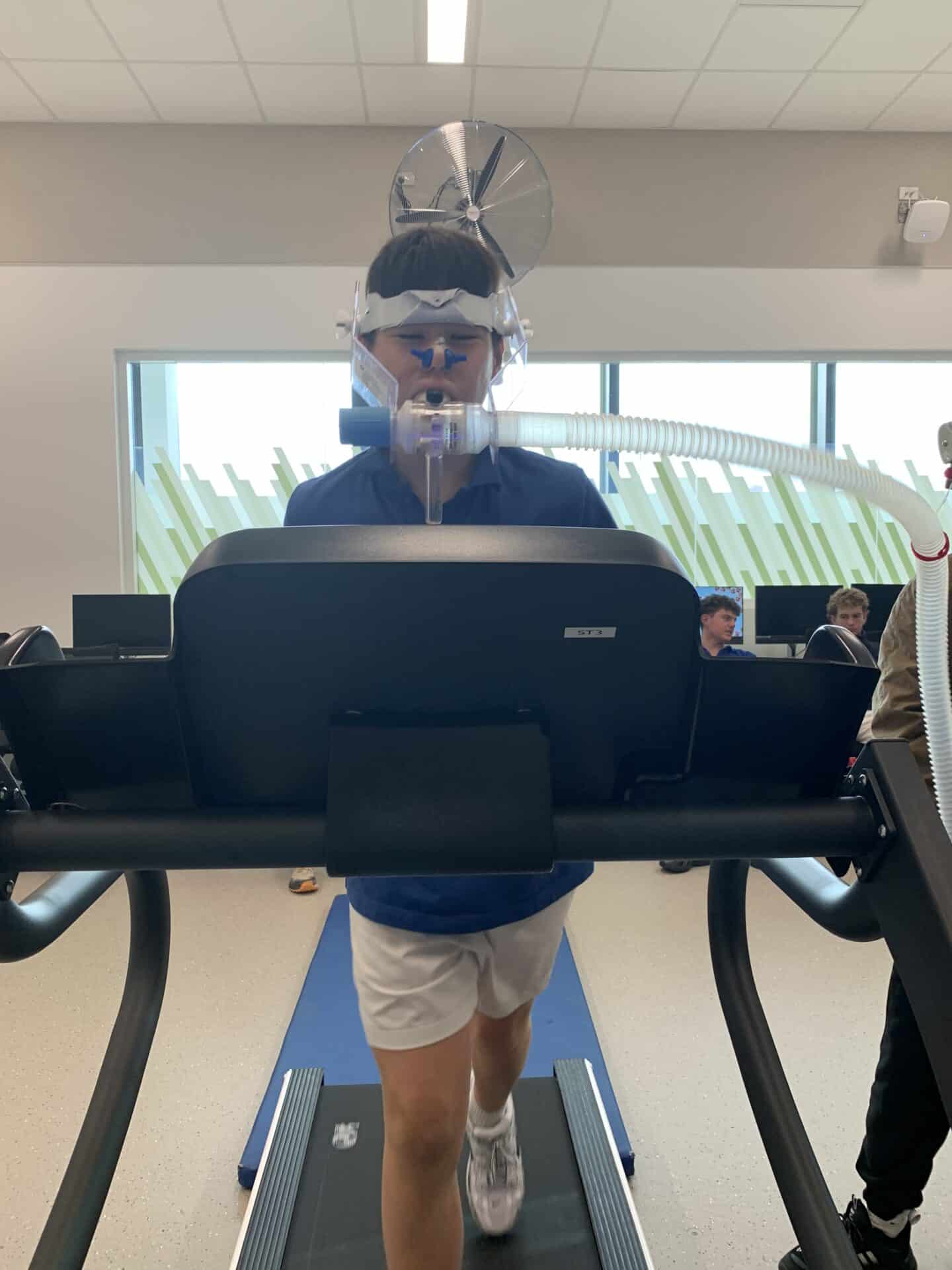
Matthew Harris (pictured), was one of the students who participated in the VO2 max test. Matthew has reflected on the experiment below:
“I was fortunate to be chosen to take part in a VO2 max test, in which I was pushed to my limits whilst having my heart rate monitored. This involved me running on a treadmill at gradually increasing speeds, until I couldn’t go any faster. I was wearing a facemask, which was connected to an oxygen machine, while being forced to breathe in and out through my mouth.”
Students were also able to participate in an Astrand test, which involved six minutes of cycling on a bicycle at a steady pace. This was conducted in a gym environment to establish a baseline, before we conducted the same experiment in the environmental chamber. The chamber was set to 3000 foot altitude, which had 15% less oxygen in the air than we had in the gym. The chamber was also at 30 degrees celsius and approximately 70% humidity. This was quite the challenge for the boys, who all found a significant jump of 15-20 beats per minute in their heart rates when cycling in the atmospheric chamber.
This excursion provided students with the opportunity to experience various tests that elite athletes would go through during their careers. It also enabled students to examine the effects of altitude and other atmospheric conditions on their heart rate during exercise, linking together with recent learning conducted at school, such as maximal heart rates during exercise, and how the cardiovascular system adapts to exercise. Overall, the boys had a great experience at SASI and Adelaide University Sports Science Hub and said it was a great opportunity to link practical tests and concepts with the theory they had learnt at school.
David McNulty
Teacher – WHPE Faculty