20 February 2026
A reflection on ‘Why row?’
Earlier this term, I shared the following reflection with our rowing families in response to a question I am often asked: Why rowing?
My long-term goal has been to convey my thoughts on schoolboy rowing to those who may only hear murmurings about it from others, or who see it only through the lens of gruelling early mornings, painful blisters and endless commuting. As I already know, and I hope you will soon too, there is more to the question, and the answer, than what meets the eye. In truth, the real answer lies deep within your son, and it is a story worth telling.
In seeking to give shape to that story, I was fortunate to spend many hours in conversation with school parent Mark Roberts KC, whose insight and generosity of thought helped refine what follows. Like peeling an onion, each layer we uncovered in our quest to explain the essence of rowing revealed another — occasionally reducing Mark to tears. Together, we searched for the right words to paint the picture I wanted to share.
With Mark’s generous assistance, this reflection attempts to articulate what I believe rowing offers our boys beyond the visible demands of the sport.
We are unapologetic about the length of this piece because we believe the journey the boys embark on when joining the St Peter’s College rowing programme deserves to be told in full. Please persevere and enjoy. For those of you in the programme, I hope you recognise the journey.
Wade Hall-Craggs
Head of Rowing
___________________________________________________________________
The Silent Symphony of Oars: How Rowing Shapes Young Men for Life
By Wade Hall-Craggs, January 2026
“Why rowing?” you ask; an intriguing question that was recently explored as part of Sport New Zealand’s Voice of the Participant survey where 9 out of 10 respondents reported that ‘participating’ in rowing had helped them develop life skills.
“I think what our sport [has created] is a wonderful life leadership program packaged up as rowing. If you said to the average 14- year old I’m going to put you through a leadership program for the next five years, they would roll their eyes and go ‘oh God’! But we just call it rowing.” – RNZ CEO Simon Wickham
The romantic, may well respond as British novelist Kenneth Grahame did, on behalf of Ratty, in the captivating tale of The Wind in the Willows:
“There is nothing – absolutely nothing – half so much worth doing as simply messing about in boats”.
Apart from the obvious allure of being around water and boats, and its attractiveness as a sport that demands outdoor participation away from screens, the answer may also lie in the unseen; what rowing is able to offer; its powerful influence on the development of young minds. It is not by chance that rowing thrives in educational institutions around the world.
For those new to rowing, please allow me to explain, and suggest what it is that inspires so many of our recent St Peter’s College graduates to continue after school as coaches.
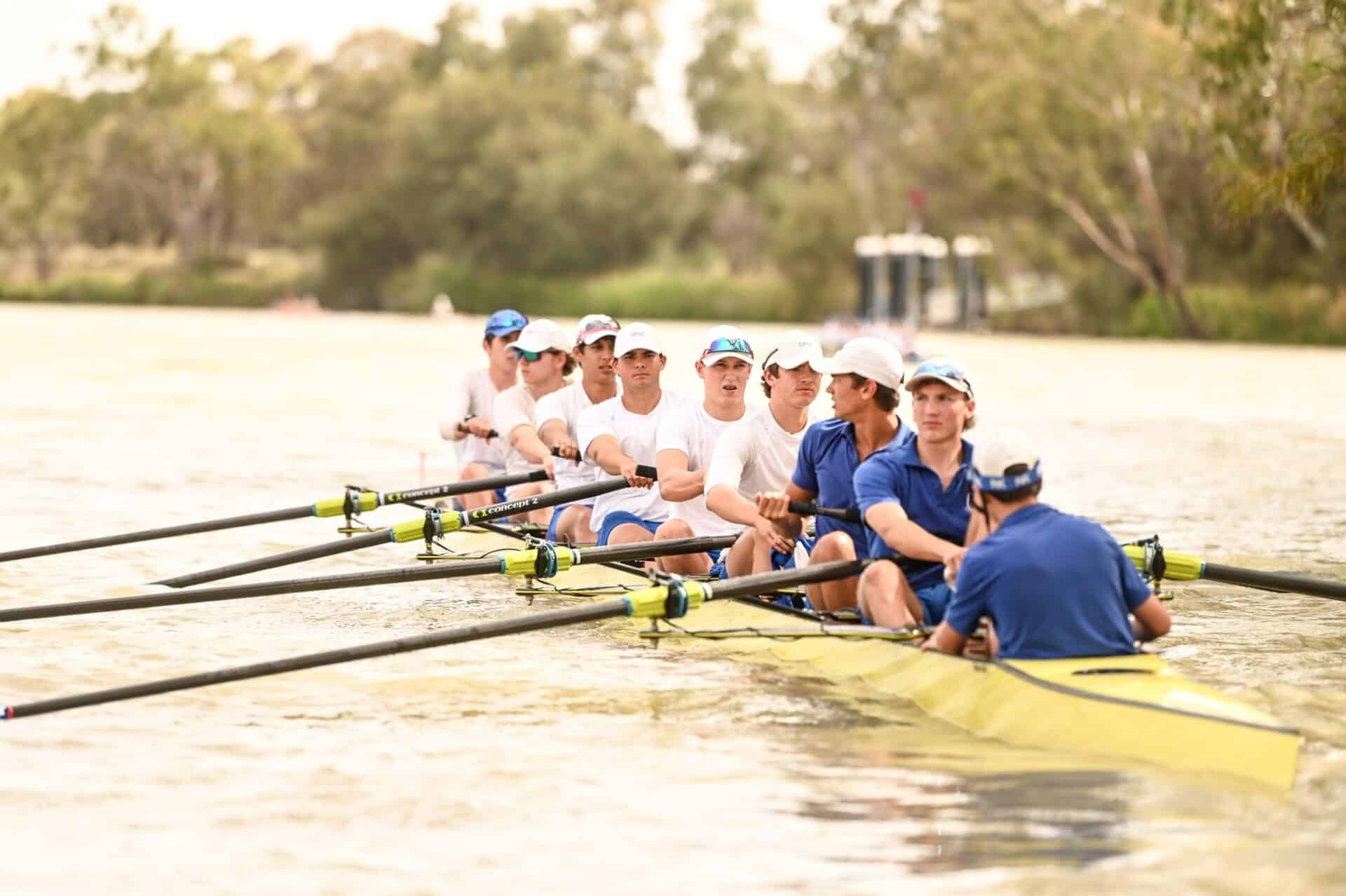
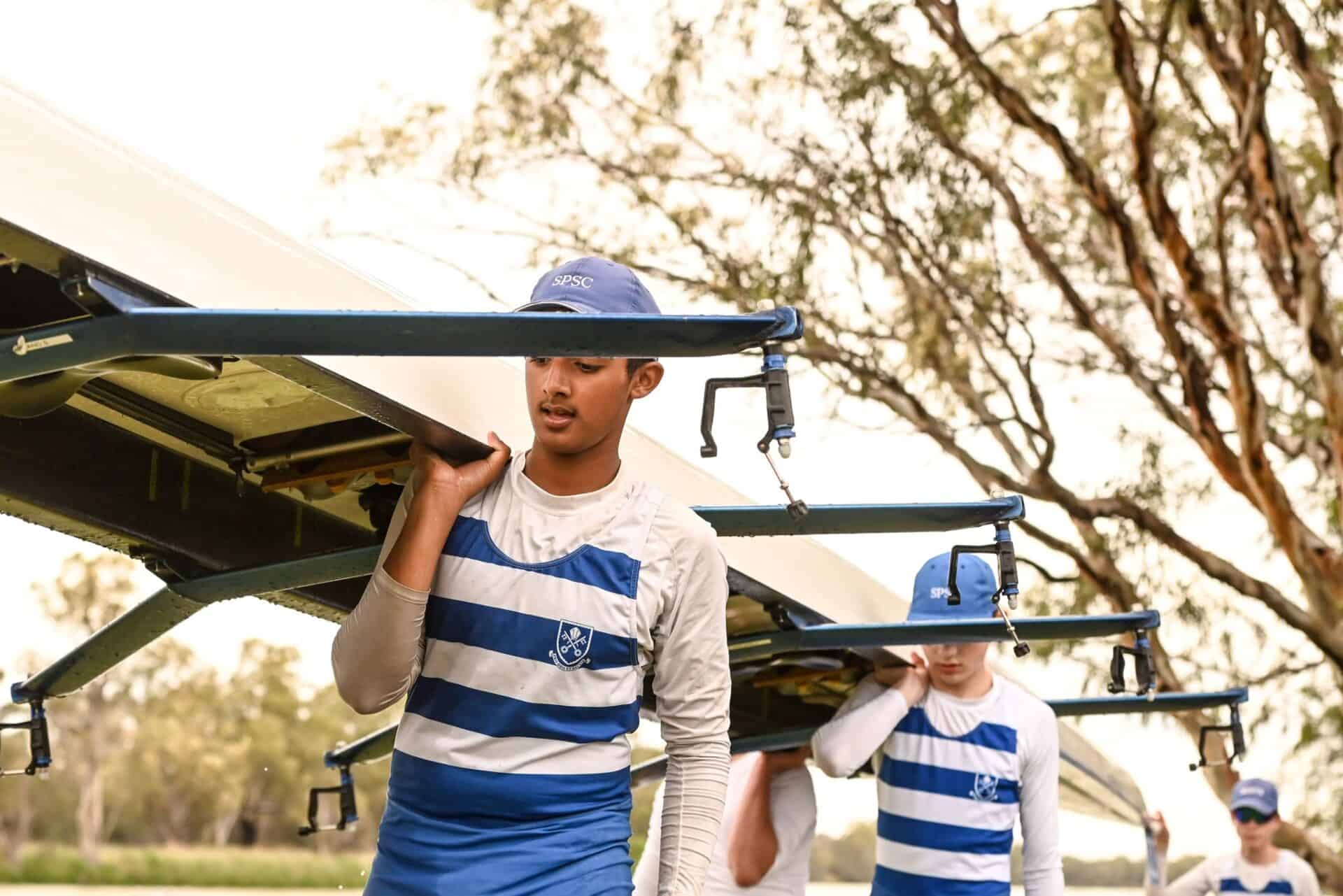
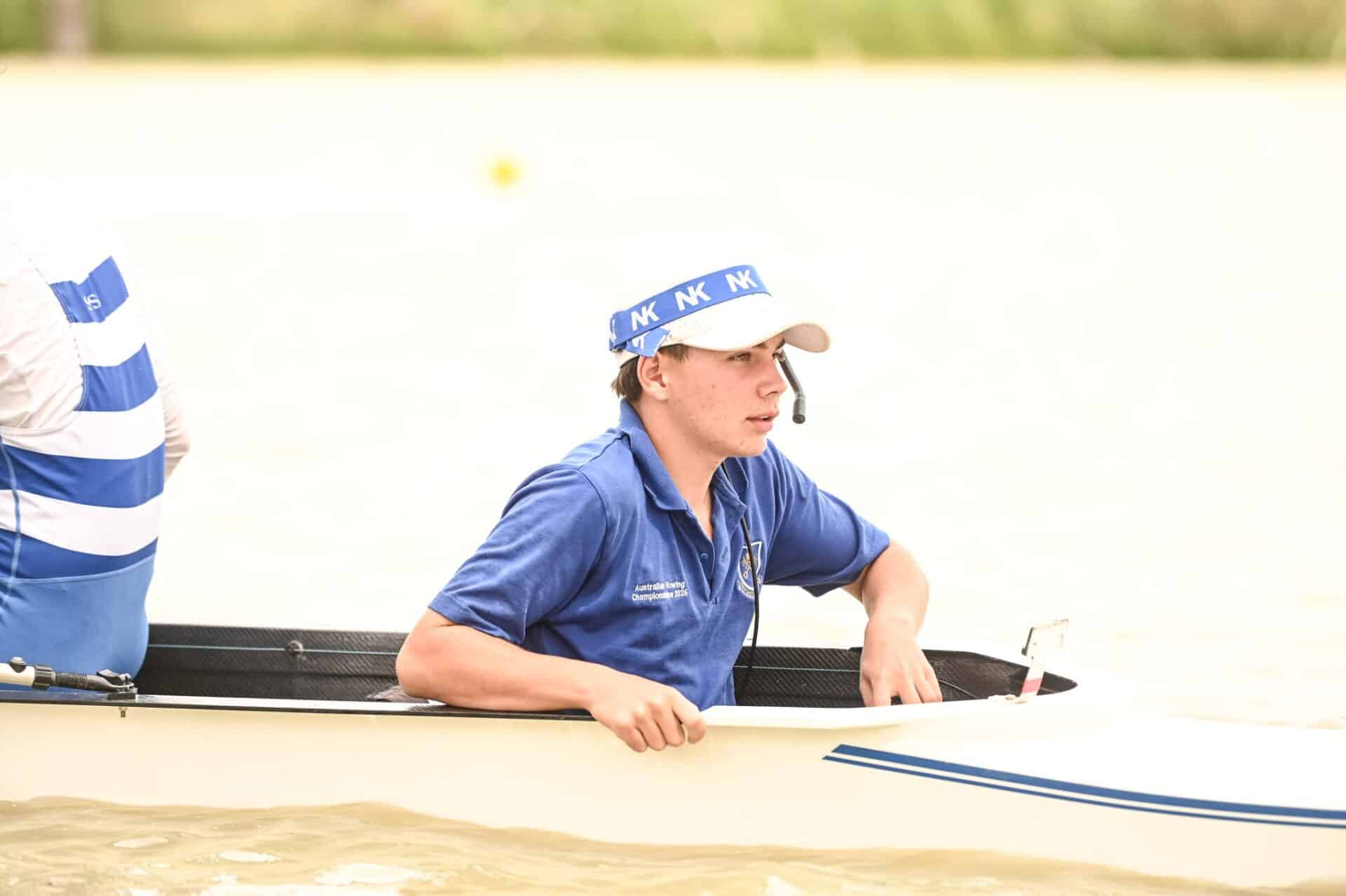
There is a beating pulse in a rowing boat at full flight that feels (naturally) magnetic; a rhythm that radiates; an energy that both captivates and connects. A rhythm that harks back to the beating drum on Greek triremes and Viking long boats. This is what underscores rowing – understanding, as rowers come to learn, that a boat glides across the water, propelled not by one, but by the entire crew, the coxswain and coaching staff – each stroke a testament to the unity, strength, and purpose of the collective. For young men stepping into this world, rowing becomes far more than a sport, but a safe environment of self-exploration. It serves as a place where their character develops, virtues are challenged and lasting values ingrained. It is the ultimate team sport – nine hearts beating as one, nine minds focused on a single pursuit. In rowing, strength is shared, not hoarded. Victory belongs to the crew, never the individual.
At its heart, rowing may be said to encapsulate three core virtues, which we at St Peters College refer to as pillars: camaraderie, work ethic and resilience.
These are not mere words; they are living and breathing principles, that shape each crew and the boys into men of substance, and which underpin the philosophy of our rowing programme.
The First Pillar: Camaraderie – The Brotherhood of the Boat
“If you pull on an oar you are a rower and you are part of my family.” Olaf Karl Tufte, Norwegian seven time Olympian, dual gold medallist and world champion.
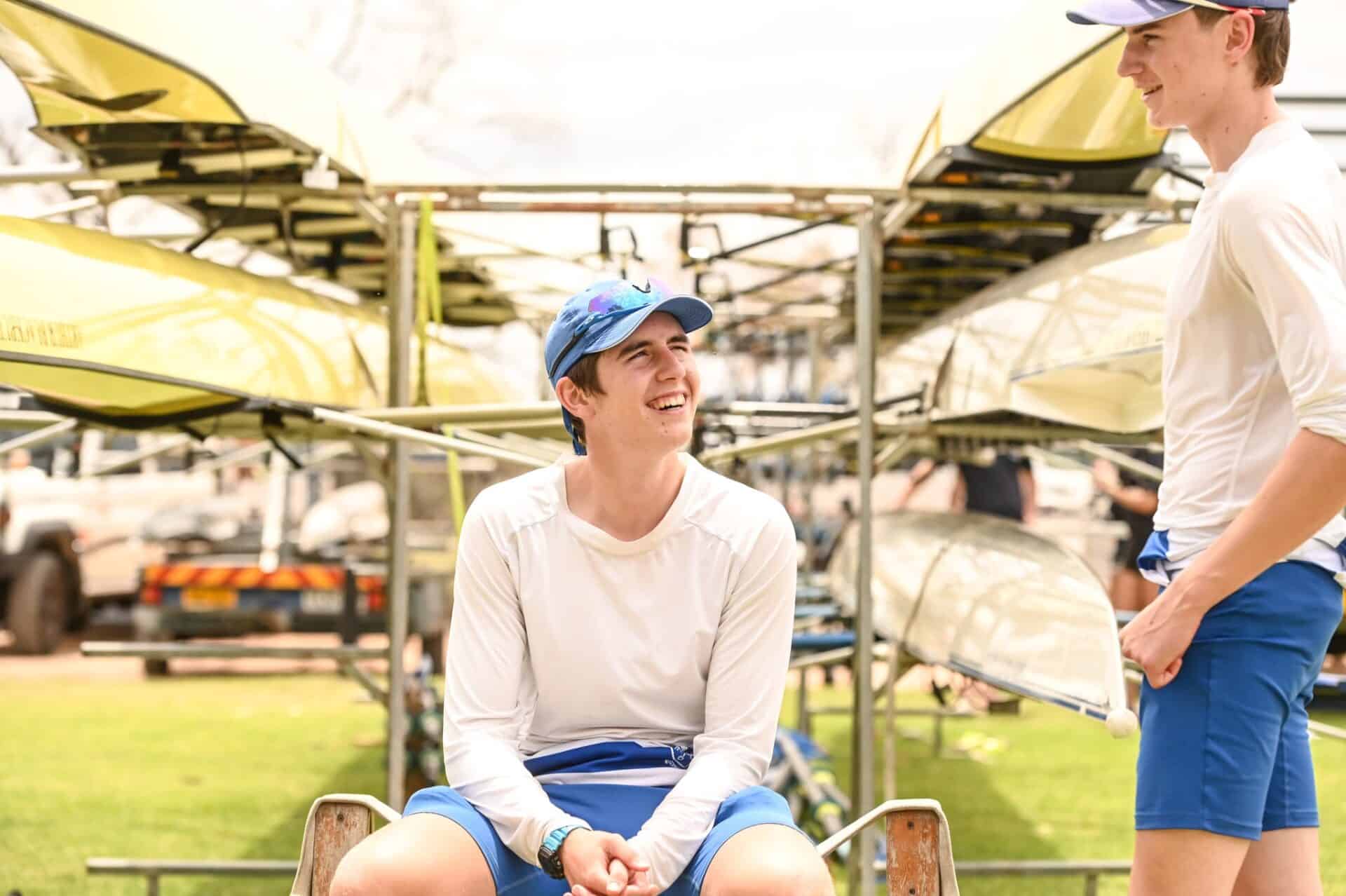
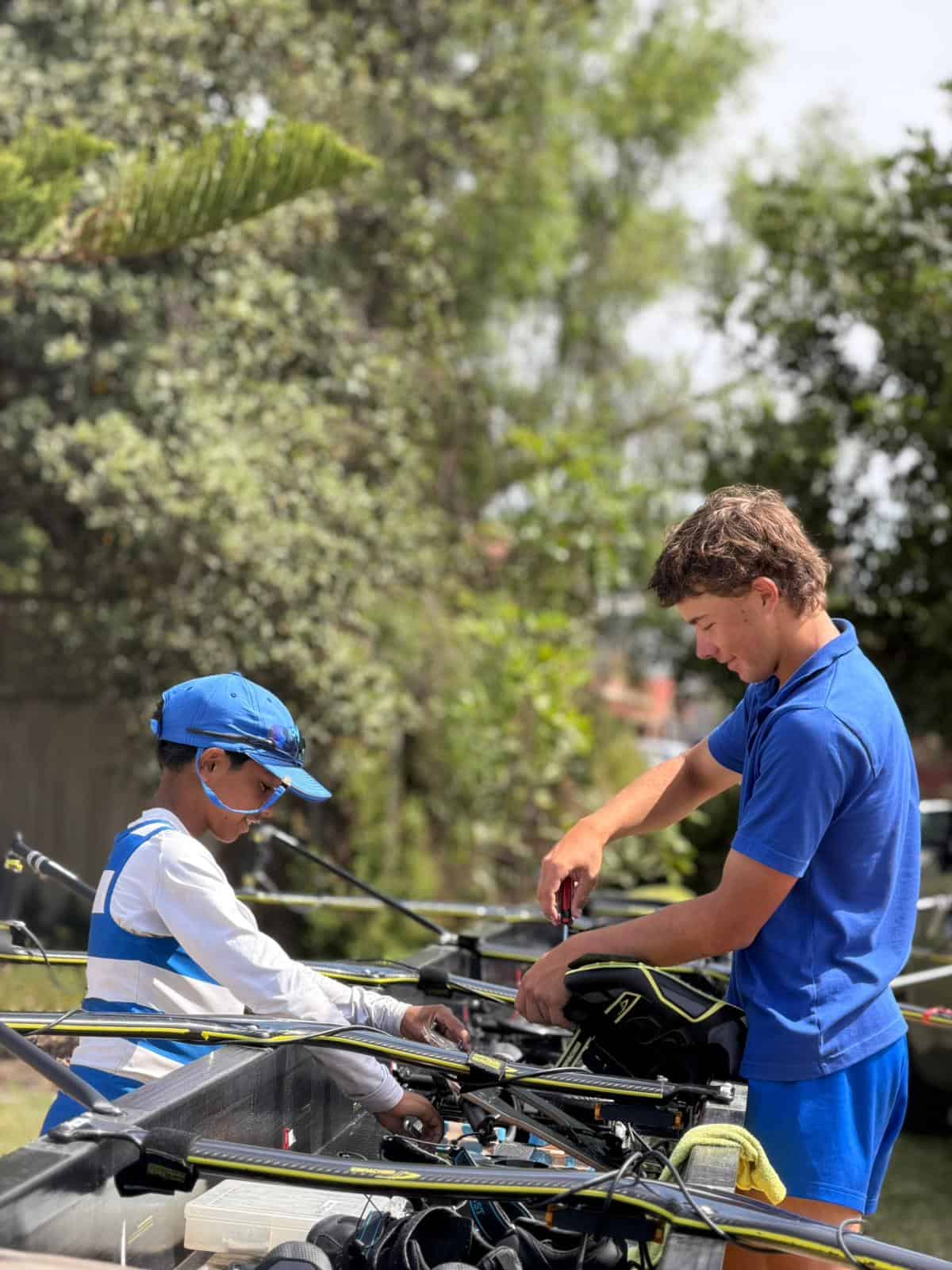
Rowing is a sport like few others. It begins and ends with togetherness. From the first day a boy grips an oar, he learns that success is never solitary. The boat moves only as intended when all move as one. This is mateship, the unspoken promise: leave no one behind. It is friendship born in shared early mornings and long sessions, fellowship that binds boys in laughter and hardship alike. It is team spirit, the heartbeat of every crew.
Camaraderie teaches solidarity – when the water turns rough, you pull harder, not for yourself, but for the boy behind you. It teaches companionship, the joy of shared effort, and true closeness – the trust that your crew will never abandon you. In rowing, brotherhood is not a metaphor; it is a reality. Every stroke whispers the same truth:
Only together, can we triumph, only together, can we triumph…
The Second Pillar: Work Ethic – The Inner Compass?
“While power is important, efficiency is critical. Many have worked hard and gone slow.” Drew Ginn OAM, Australian multiple world champion, four time Olympian and triple gold medallist, and member of the infamous Oarsome Foursome.
Beyond strength lies integrity. Rowing necessarily demands spirit, honesty and respect – values that endure long after the race is done. Ethics in rowing is about doing the right thing when no is watching. It is responsibility, owning your role in the boat and your place within a space far greater than you. It is accountability, knowing that every stroke matters; that you are not merely cheating yourself by not giving your best, but every person in your crew. No one can see how hard you are pulling; only you know what you are prepared to put in for yourself and your crew. Let no one down.
Ethics teaches discipline, the backbone of excellence. It teaches respect, for teammates, for opponents, and for the craft itself. It teaches sportsmanship, the grace to win humbly and lose nobly. In a world that often bends the truth, rowing stands firm. It reminds young men that character is not built in comfort but in choices – and the right choice is always worth making and fighting for.
The Third Pillar: Resilience – The Fire Within
“Why row? Because it is hard. Life is hard. Rowing prepares you for life.” Kim Brennan, sixteen time Australian national champion, two time world champion, three time Olympian and gold medallist.
Rowing is not easy. It is early mornings, aching muscles, and relentless hours on ergs and on the water. But in that struggle lies its greatest gifts, resilience: the ability to endure and adapt under pressure; fortitude: the inner strength to persist through challenge, to find calm in the chaos; and perseverance: an unwavering determination to keep going – values forged in every pull of the oar. In colloquial language we refer to these things as grit, the refusal to quit when the body begs for rest. The courage to push through pain. It is mental toughness; the steel that holds when storms rise. The self-belief to keep going when the going gets tough. Earn your own respect.
“If you can meet with triumph and disaster and treat those two imposters just the same.” Rudyard Kipling.
In rowing, the boys learn that life will not always be smooth nor easy – but with resilience, fortitude and perseverance, they will have tried and tested tools to find a way forward. They learn to embrace the inevitability of disappointment. When a race or erg test goes awry, as it will, there is only one thing that makes it a failure, and it is not about by how much they missed their desired time or missed crew selection. Rather, the boys learn from early on that a race or test has only truly gone wrong if they fail to learn from it; recognising that failure is a critical part, perhaps the most critical, of getting faster and is the best way to uncover what they truly need to work on to improve, which allows for them to become a better rower and a more rounded individual. As in school, as in life, a failure to achieve immediate success is often the most powerful of learning tools and needs to be seen as such.
It is also through the prism of these words and concepts that we pursue the holy grail of rowing – being at one with your craft, your crew, yourself.
“The best moments usually occur when a person’s body or mind is stretched to its limits in a voluntary effort to accomplish something difficult and worthwhile.” Mihaly Csikszentmihalyi, psychologist and author of ‘Flow’.
We have all experienced moments of flow in our everyday lives; where things just begin to click, with your brain seamlessly joining the dots without conscious effort. Where things happen perfectly. One of the core components of Csikszentmihalyi’s theory is that flow state consciousness is most likely achieved when a high level of challenge is matched with a high level of skill.
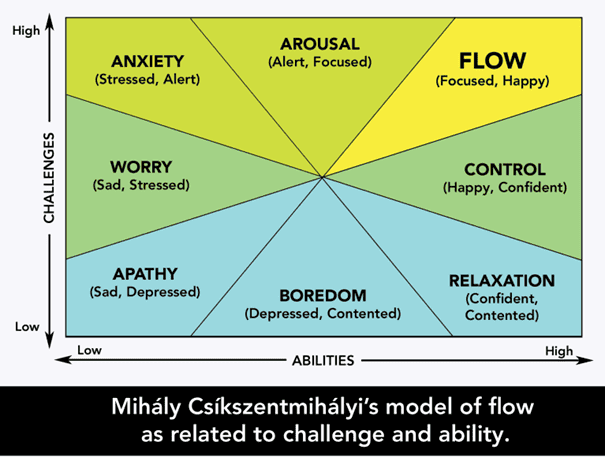
Csikszentmihalyi’s theory is where you land on this chart determines your experience. A test that is too easy combined with a low level of ability or skill will lead to a state of boredom and apathy, while a test that is too hard for your current level of skill will lead to anxiety and stress. The sweet spot to achieve flow state is when you have developed a high level of skill and this is met by a high level of challenge. This leads to heightened focus and happiness.
In rowing parlance, flow state consciousness describes the state of intrinsic motivation and focus where every member of the crew is, at that moment in time, so completely immersed in their collective pursuit of the challenge that there develops an unparalleled subconscious harmony between body, boat, and water. The rhythm of the boat is all; you are totally present in the moment. Time fades away. It is where it seems easy to go fast. The boat works for you rather than the other way around.
Achieving flow state is challenging and not fully understood. It is not something initiated simply by the flick of a switch. Instead, it requires a fundamental commitment to embrace risk, matched by the required skills to thrive in those conditions. It is pursued by training the boys by matching their current abilities with expectations; by instilling in them the courage to have a growth focused mindset and the belief that they have the capacity to improve beyond their current ability, thereby permitting the brain to accept tougher and realizable challenges.
This is something that can only be fostered over time and with a relentless acceptance of the core fundamental tenets underpinning work ethic.
The Pillars of Growth: From Year 7 to the Seniors
Built upon these pillars sits the pediment; the pyramid of development, each stone carefully placed, layer upon layer – each year building on the last.
At St Peter’s College, our programme follows the principles of Dr. Istvan Balyi’s Long-Term Athletic Development (LTAD) model.
It provides a framework designed to optimise the development of athletes, over time, addressing the physical, mental, and emotional needs at different stages of their growth and development. It recognises that in team sports it is important to see the individual. It is rooted in scientific principles and aims to ensure that boys reach their full potential while minimising the risk of injury and burnout.
Year 7 – The Foundation of Discovery
For the youngest rowers, rowing is fun, a new adventure. It is about learning the basics, feeling the thrill of the boat, and tasting the first drops of camaraderie. Here, the seeds of ethics and resilience are sown gently, through encouragement and play.
Year 8 – The Spark of Belonging
The boys begin to understand team spirit. They realise that every effort counts, that unity brings newly discovered speed. Ethics emerges in small acts – sharing encouragement, respecting coaches. Resilience that flickers in the first hard sessions, teaching them progress demands persistence. Boys unknowingly begin to learn about the principles underpinning flow state consciousness. The excitement and jubilation of competing in their first Head of the River is realised and the seed for a future in rowing is sown.
Year 9 – The Rise of Responsibility
Now, rowing becomes shared commitment. Training intensifies, and so does the bond. Camaraderie deepens into brotherhood. Ethics becomes a conscious choice – punctuality, honesty, fairness. Resilience grows as they face tougher waters, learning that strength is best forged in struggle.
Year 10 – The Call of Leadership
The boys start to lead. They mentor juniors, embodying fellowship and responsibility. Ethics is no longer taught; it is lived. Resilience becomes second nature – they push through fatigue, driven by pride and purpose.
Year 11 – The Edge of Mastery
Nearing the summit, they row with greater precision and passion. Camaraderie is unbreakable, ethics unwavering, resilience unshakable. They understand that rowing is not just a sport but a way of life – a mirror of values that will guide them beyond school.
Year 12 – The Pinnacle of Synergy
At the top stands the seniors, the embodiment of all that rowing represents. They are leaders, mentors, and role models. They know that the whole is greater than the sum of its parts – Aristotle’s timeless truth. In their unity lies greatness, in their shared virtues lies victory.
The Keystone: A Whole Greater than the Parts
At the apex is synergy, the magic that happens when camaraderie, ethics, and resilience converge. It is holism, the understanding that rowing is more than strokes and races – it is a philosophy, a reflection of life. It is unity, where individual strengths blend into collective power. It is harmony, the silent music of oars moving as one. Being at one with the elements, the boat, the water, the crew.
Rowing is life in motion: discipline, mateship, and the courage to keep going when it hurts and easier to stop. It is not about being the strongest; it is about being the most united. This is perhaps the ultimate lesson: that our existence on earth, as in rowing, is not about standing alone, but about standing together. That greatness is not in isolation but best experienced in collaboration with family and friends. That the whole is not just greater than the sum of its parts – it is different, richer, and infinitely more beautiful. Rowing teaches that the hardest strokes are the ones that matter most – in the boat, and in life.
Rowing shapes boys into men who value friendship over rivalry, honour over shortcuts, and resilience over surrender. It teaches them that success is earned, not given; that strength is shared, not hoarded; that life’s true victories are not medals but memories, not trophies but character.
Rowing offers numerous benefits as a sport. It recognises effort while allowing for diverse strategies to achieve success. It encourages camaraderie and cultivates life skills not found in the darkness of solitary activities involving technology and gaming. This is not achieved overnight; it is carefully cultivated through each stage of growth. From the tentative first strokes in Year 7 to the confident leadership in Year 12, every lesson, win, and setback adds a unique thread to the tapestry. The journey is as much about self-discovery as it is about shared triumphs, nurturing not just athletic ability but also empathy, humility, and a sense of belonging that lasts far beyond the riverbank. Through the rhythm of shared effort and the quiet strength found in teamwork, rowing becomes a journey not just across water, but towards maturity and self-discovery. Each pull of the oar is a lesson in perseverance, each race a testament to the bonds formed along the way. In these moments, the boys come to realise that true achievement lies in lifting each other up and moving forward together.
In the stillness of dawn, as the boat slices through water, these young men learn the truths that will guide them forever: Leave no one behind. Let no one down. Earn your own respect. Never give up. For in rowing, as in life, the greatest journeys are those we take together.
For me, the question is not why row, but rather why not?